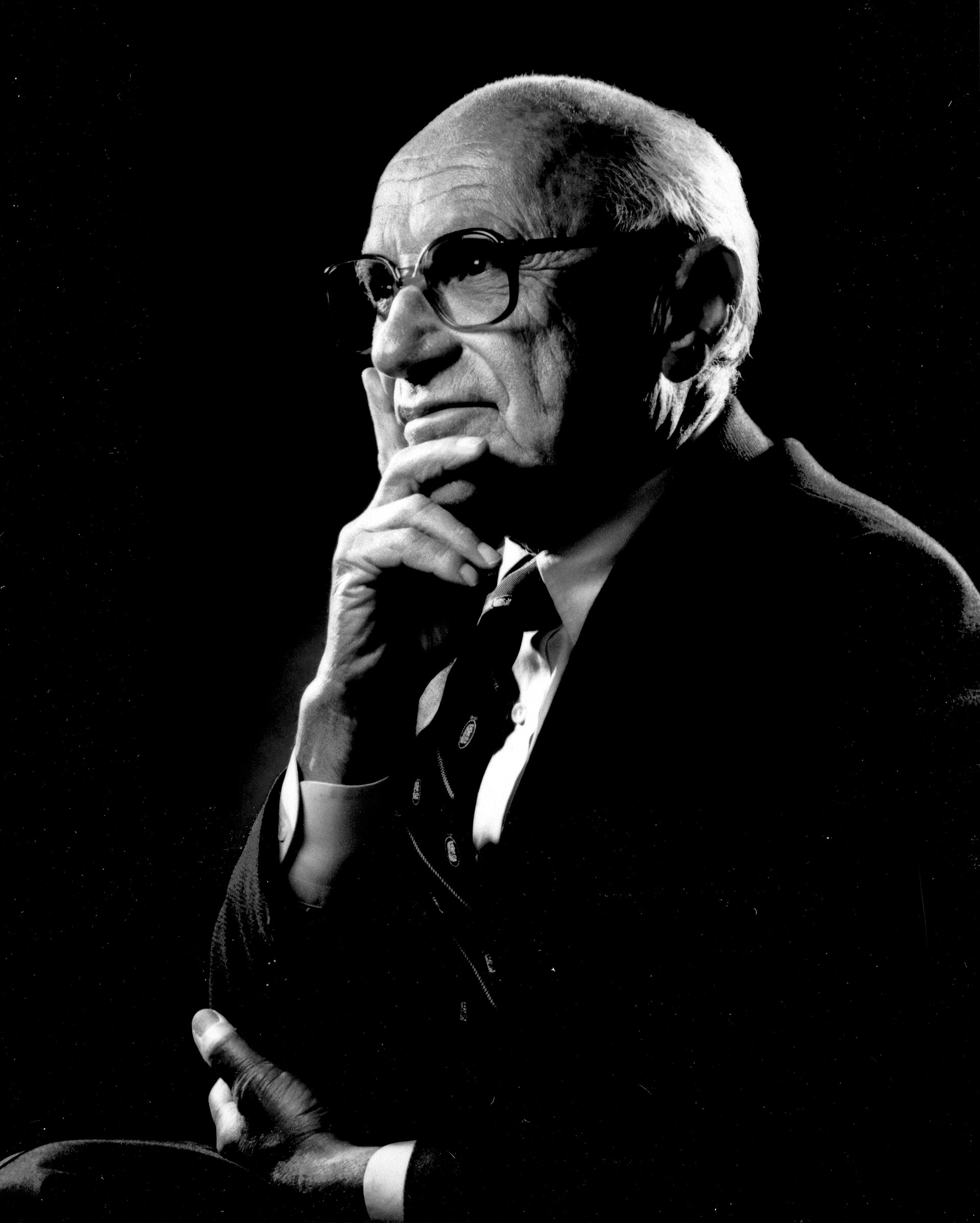
PROFILE
Milton Friedman
The Man Who Was Right, and the Bill
Economist, University of Chicago · 1912 – 2006
The Bill: What Milton Friedman Was Right About
He is not an investor, and he never managed anyone's money. He belongs here anyway, because almost every idea that governs how money works in your life came through him first, and because his career is the clearest case study in finance of what it costs to be right.
Milton Friedman was born in Brooklyn in 1912, the fourth child and first son of immigrants. The family moved to Rahway, New Jersey when he was one. His mother ran a small dry-goods store. His father ran ventures that did not work. His father died during Friedman's senior year of high school, and his mother and two older sisters carried the family from there. He graduated in 1928, just before his sixteenth birthday, and went to Rutgers on a scholarship that covered tuition and nothing else. He waited tables and clerked for the rest.
"Inflation is always and everywhere a monetary phenomenon."
The Machine He Built
In 1941 he went to work in the Treasury Department's tax research division. He was twenty-eight. The country was about to fight a war it could not pay for, and the income tax at the time was largely a tax on the wealthy, collected once a year from people who wrote a check. Friedman was one of a small technical group that worked out how to collect it from almost everyone, as they earned it.
What they produced is the thing that happens to your paycheck before you see it. Withholding turned a narrow tax into a universal one, and it is a substantial part of the reason the modern American government can afford itself. The man who spent the next sixty years arguing that government had grown too large helped build the mechanism that funds it.
He never fully disowned it. Asked about it half a century later, he said he had no apologies for it, that he wished it had not been necessary, and that he wished there were some way of abolishing it now. Those are three different sentences and he meant all of them.
The Argument Nobody Bought
In 1963, after roughly twenty years of work, he and Anna Schwartz published a book of nearly nine hundred pages on the monetary history of the United States. Its most famous section concerns the Great Depression, and it is routinely repeated wrong.
They did not argue that the Federal Reserve caused the Depression. They argued that an ordinary recession began in 1929, that the quantity of money in the economy then fell by roughly a third, and that this collapse was not inevitable. It was a product of what the central bank did and, more damningly, what it failed to do. About half the banks in the country closed or merged. In October 1931 alone, five hundred and twenty-two banks closed. The institution created in 1913 for the express purpose of stopping banking panics stood and watched.
For most of his career this was a minority position. It is now close to consensus, though the record is fuller than the slogan: later scholarship added the credit channel, which explains why the downturn was so deep and so long, and the international gold-standard constraint, which explains a good deal of why central banks behaved as they did. Friedman was right about the largest thing and the profession spent sixty years supplying the machinery he left out.
A note on the second name on that cover. Anna Schwartz built the reading list that oriented Friedman to the history, worked through the bank statistics, calculated the columns of vault cash, and traveled for data nobody had collected. On paper he directed and she assisted. Columbia withheld her doctorate until 1964, first on the grounds that the manuscript was co-authored and then on the grounds that it was already in print. She never held a tenured university appointment. Friedman, to his credit, wrote to the department and told them she had demonstrated her qualifications by any standard whatsoever.
Chile
In March 1975 Friedman spent five days in Chile, eighteen months into a military dictatorship that was imprisoning, disappearing and killing people. He gave public lectures, met Augusto Pinochet once for less than an hour, and afterward, at Pinochet's request, wrote him a letter prescribing rapid rather than gradual measures against an inflation running, by Friedman's own account, at ten to twenty percent a month.
The record is worth stating precisely, because it is usually not. He was never an advisor to that government, held no position in it, and did not run the exchange program that trained the Chilean economists who took those jobs. His colleague Arnold Harberger was the one most heavily involved in that and traveled there constantly. Friedman taught a required theory course in Chicago.
In a 1991 lecture he said he had nothing good to say about the political regime Pinochet imposed, and called it a terrible political regime. In the speeches and interviews most often quoted in his defense, he condemns the regime and does not name the torture, the disappearances, or the dead. Historians remain divided on how much he actually changed, and the dispute is live rather than settled.
October 1979
By 1979 American inflation was running near twelve percent and had been climbing for a decade. Friedman's claim, held since 1963, was that inflation comes from the quantity of money growing faster than the quantity of goods, that the central bank controls the quantity of money, and that inflation is therefore the central bank's responsibility. Not oil prices, not unions, not shopkeepers.
On Saturday the sixth of October 1979, Paul Volcker's Federal Reserve voted unanimously to change how it operated: it would manage the supply of reserves to the banking system and let interest rates go where they went. Asked at a press conference that evening whether this would slow the economy, Volcker said he did not think it would have important effects in that connection.
It produced the worst recession since the Depression. The federal funds rate, the overnight rate between banks that nearly every other rate is built on, touched twenty-two percent in July 1981. Unemployment reached 10.8 percent in late 1982. Housing construction collapsed to near record lows. Inflation broke.
What It Cost
Three years later the Federal Reserve quietly stopped. In October 1982 it set no target for the narrow money measure at all.
The reason is the part that rarely gets told, and it is the most useful thing in this profile. The approach depends on a stable relationship between the quantity of money and the amount of spending. Economists call that relationship velocity, meaning how many times a dollar changes hands in a year. If velocity is steady, controlling money controls prices. In the early 1980s it stopped being steady. Bank deregulation created accounts that paid interest but still spent like checking, so the boundary between money and not-money moved underneath the measurement. And the disinflation itself changed how much cash people wanted to hold. The instrument stopped reading true partly because the policy had worked.
Friedman kept watching the money supply after the Fed stopped. In 1983 he warned of a return to double-digit inflation. In 1984 he forecast prices rising eight to ten percent in 1985. In 1985 he said inflation would be higher the following year. Inflation stayed below five percent every month from 1983 through 1986.
In a Financial Times profile published in June 2003, at ninety, he said that the use of the quantity of money as a target had not been a success, and that he was not sure he would push it as hard today as he once did.
What Survived
On the eighth of November 2002, at a conference for Friedman's ninetieth birthday, Federal Reserve Governor Ben Bernanke closed his remarks by saying that regarding the Great Depression, Friedman and Schwartz were right, the Fed did it, the Fed was very sorry, and thanks to them it would not do it again. He addressed it to Milton and Anna.
What was absorbed into central banking: that inflation is the central bank's responsibility, that expectations and credibility are the channel through which policy works, that the bank should state a numerical objective and be judged against it, and that there is no permanent trade in which a country buys lower unemployment with permanently higher inflation. He argued that last point in 1968 and the 1970s proved it while he watched.
What was discarded: money-growth targets as an operating guide, and the fixed-percentage rule he spent his career advocating, which no central bank ever adopted as binding. Modern inflation targeting is not monetarism. It abandons the money-to-spending link entirely and aims at the inflation rate directly, using a short-term interest rate as the instrument. What carried over was the objective and the discipline, not the machinery.
That is the shape of the whole career. He was right about more than his critics allow, and each time the world agreed with him, somebody paid for it.