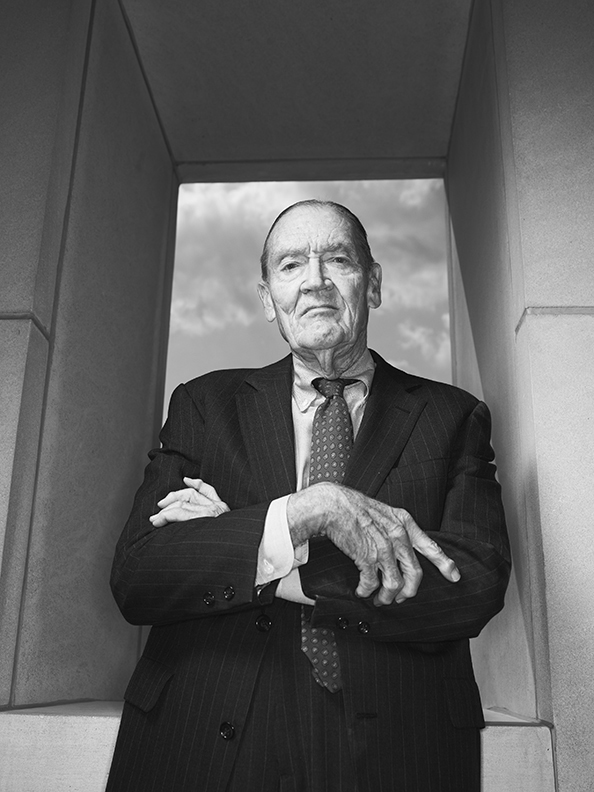
INVESTOR PROFILE
Jack Bogle
The Common Man's Man
Founder, Vanguard Group · 1929 – 2019
The Common Man's Man: Jack Bogle
Jack Bogle was born in 1929, the same year the stock market began its 89% collapse. His family's accumulated wealth was among the losses. He entered the world at the exact moment the money ran out -- and spent the next ninety years making sure ordinary investors had somewhere to put theirs.
He created the first index fund available to individual investors in 1976. Wall Street called it "Bogle's Folly." The fund raised $11 million against a $150 million target. It now manages $1.5 trillion. The Vanguard Group, the firm he built around the same idea, manages more than $8 trillion. Bogle never became a billionaire from any of it. That was the point.
"Don't look for the needle in the haystack. Just buy the haystack."
Born Into the Wreckage
The family had been comfortable. Upper-middle, maybe more -- the kind of stability that felt permanent until it wasn't. The Depression removed it. His father lost his job, started drinking, drifted. His parents divorced. The money was gone.
Bogle won a scholarship to Blair Academy prep school, then to Princeton. He was there as someone eating on a scholarship who took a job serving food in the dining hall to the sons of families whose money had survived the crash. He watched. He studied. He graduated magna cum laude in economics in 1951.
For his senior thesis, he chose to examine the mutual fund industry. The argument was simple and the data was clear: funds, on average, did not beat the market. The fees compounded against the investor. The performance claims were unreliable. The industry was structurally misaligned with the people it was supposed to serve. He was twenty-two years old and had never managed a dollar of institutional capital.
He was right. The industry would spend the next fifty years proving him right while pretending otherwise.
The Firing
He went to Wellington Management after Princeton. Research analyst, then executive, then CEO. At the top, he made the decision that defined everything that followed: in 1966, he approved a merger with Thorndike, Doran, Paine & Lewis, a Boston growth-fund shop riding the go-go era. Growth funds were hot. The merger made Wellington look current. It seemed like the right call.
By 1973, the go-go era was over. The growth funds had cratered. The partners who came in through the merger had enough board control to remove him. In January 1974, they did. He was forty-five years old.
"I left my old job," he said later, "exactly the same way I took on my new job: fired with enthusiasm."
He founded Vanguard that year. The SEC ruled the new entity could not actively manage funds -- only administer them. What looked like a regulatory limitation became the thesis. He would administer a fund that tracked the index, charged nothing extra, and owned the entire market. The constraint forced the invention.
Bogle's Folly
The First Index Investment Trust launched August 31, 1976. It tracked the S&P 500. It charged a fraction of what any active fund charged. Wall Street's response was unified.
Fidelity's chairman, Edward Johnson III, said publicly he couldn't believe any serious investor would settle for average returns. Dean Witter's brokers refused to sell it. The underwriting raised $11.3 million. The target had been $50 to $150 million. The worst fund IPO in Wall Street history, by a wide margin.
They called it "Bogle's Folly." Not quietly. On the record, in the press, to clients.
He kept going. He had no outside shareholders to appease, no personal equity at stake. The structure he had designed -- in which the funds own the management company, not the other way around -- meant there was no one to answer to except the investors whose money was in the fund. They owned the firm. He was on salary. There was nothing to cash out.
The Machine With No Owner
Here is the structural move that separates Bogle from every other name in finance.
A conventional asset manager takes a management fee -- typically 0.5 to 1.5% annually -- as revenue for the firm and its owners. Over decades, this compounds into enormous personal wealth for the founders. Bogle structured Vanguard so that the funds own the management company. No outside owners. No profit extraction. The only mandate is to minimize costs.
As a result, Vanguard's expense ratios fell to 0.03%. The industry average was 1.1%. On a $500,000 retirement account, that difference is $5,350 per year. Over thirty years, compounded, it is the difference between retiring with your number and retiring with a problem.
Bogle built one of the world's largest financial institutions. He never became a billionaire from it. He was on salary. He chose this deliberately, structured it irreversibly, and never expressed regret about the personal cost. He expressed regret that more people didn't understand the structural argument sooner.
"The stock market is a giant distraction to the business of investing."
Six Attacks
He had his first heart attack at thirty-one.
Five more followed across the next thirty-five years. He worked through each one -- building Vanguard, writing shareholder letters, testifying before Congress, arguing the same case in speeches and books and op-eds with the patience of a man who knew the data was on his side and was willing to wait for everyone else to read it.
By 1996, his heart was so damaged that doctors estimated he had roughly one year without intervention. He received a transplant in December of that year. He was sixty-seven. He lived another twenty-three years.
He described himself using the myth of Antaeus -- the giant son of Poseidon who gained strength every time he was thrown to the ground, because contact with the earth renewed him. Every knockdown rebuilt him. The Depression. The divorce. The firing. The Folly. The six attacks. The transplant. He appeared to mean this literally.
He died January 16, 2019. He was eighty-nine years old. He was in Bryn Mawr, Pennsylvania, ten miles from Vanguard's headquarters in Malvern.
The Verdict
SPIVA data -- the S&P's annual performance scorecard -- shows that over any 15-year period, 80 to 90% of actively managed funds underperform their benchmark index. After fees. That's not a bad year. That's a structural, measurable fact across five decades of data. Bogle argued this in his Princeton thesis in 1951, using far less data. He just had to wait for the industry to generate enough evidence to make the case unanswerable.
In 2017, Warren Buffett told Berkshire Hathaway shareholders what instructions he'd leave his estate. Not: invest in Berkshire. His answer: put 90% in an S&P 500 index fund -- specifically, Vanguard -- and 10% in short-term government bonds. The man who beat the market for sixty years recommended the product built by the man who argued you couldn't.
At Bogle's death in 2019, Buffett said: "Jack did more for American investors as a whole than any individual I've known."
Vanguard managed $8 trillion at the time. It had started with $11 million that nobody wanted.
Against the Grain
The man who grew up serving food to wealthy Princeton students built the thing that gave those students' children's financial advisors a structural problem. The man fired at forty-five chose, at the founding moment of his institution, not to build personal equity in it. The man who fought the fee-collecting establishment made fighting them permanent by locking it into the ownership structure.
He was not playing the same game as everyone else and hoping to win. He was changing the rules so that everyone else's game produced worse results than his, compounded daily, for decades. He did it by saying the quiet part out loud -- your financial advisor is probably not beating the market and the management fee is your retirement -- and then proving it structurally rather than just arguing it in print.
The industry didn't change because of him. But it changed in spite of itself because of what he built. And the data is now so long and so complete that even the most committed active manager cannot honestly argue against him. They have started building their own index funds instead. After forty years of calling him naive, they have concluded that the only way to compete with Vanguard is to become Vanguard.
He was right in 1951. He was right in 1976. He was right at eighty-nine.
His last public statement to the investment industry, delivered not long before his death: "Don't forget the little guy you serve."
He never did.
John Clifton Bogle. Born May 8, 1929, Montclair, New Jersey. Died January 16, 2019, Bryn Mawr, Pennsylvania. Founder, Vanguard Group. Creator of the first retail index fund. Owner of no equity in either.