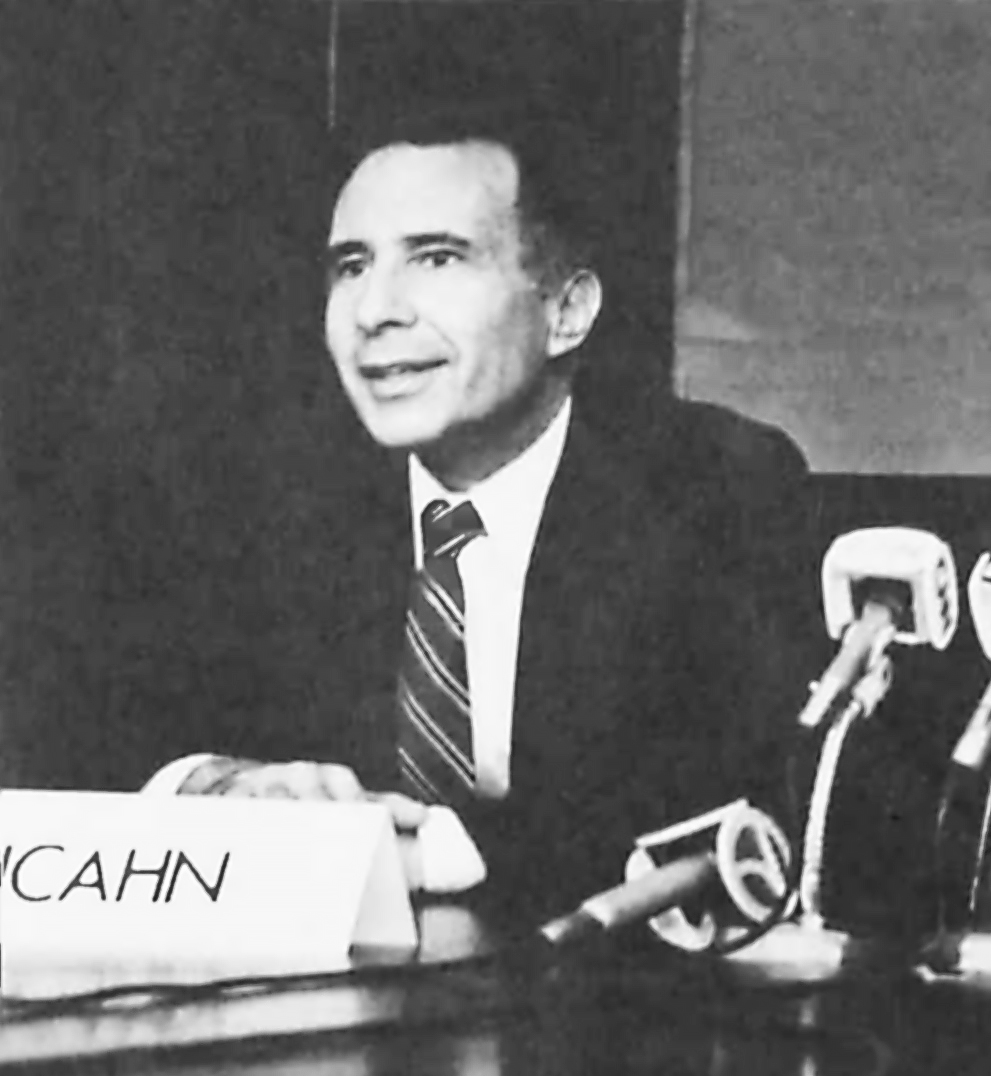
INVESTOR PROFILE
Carl Icahn
The Last Raider
Far Rockaway, Queens · Princeton, Class of '57 · b. 1936
The Last Raider: Carl Icahn
Autumn, 2013. Tim Cook's phone rings. On the other end is a seventy-seven-year-old man from Queens with a voice like sandpaper on a boardroom table. Carl Icahn has just bought a billion dollars of Apple stock -- quietly, the way he's been buying things for half a century -- and now he wants to talk.
He's polite. He compliments the products. Mentions the stock looks cheap. And then he makes his suggestion -- delivered with the patient tone of a man who has spent a lifetime making suggestions that are not suggestions at all: Apple should buy back a hundred and fifty billion dollars of its own shares.
Cook listened. The board listened. Within months, Apple announced the largest share repurchase program in the history of capitalism. The stock surged. Icahn's position swelled by billions.
He tweeted about it. Tweeted. This man who'd been kicking down boardroom doors since Lyndon Johnson was president -- reduced his thesis on the most valuable company on earth to a hundred and forty characters. As if the whole thing had been obvious and everyone else had just been too comfortable to say it.
That's the story Carl Icahn tells about himself. Has been telling it for sixty years. That he sees what everyone else refuses to see. That he acts while the rest of them sit around debating. That the emperors of American business are, more often than not, buck naked -- and he's the only one rude enough to say so.
"Some people get rich studying artificial intelligence. Me, I make money studying natural stupidity."
The Kid from Far Rockaway
Carl Celian Icahn came into this world on February 16th, 1936, in Far Rockaway, Queens -- a neighborhood clinging to the ass end of New York City like it wasn't sure it belonged. Jewish and Italian families, mostly. Working people who treated respectability like a second job.
His father, Michael, was a cantor -- a singer in the synagogue. Beautiful voice. But here's what matters: Michael Icahn was also a frustrated intellectual. Smart enough to have done something real with his life. Never did. Carl watched that every day -- watched a man with genuine ability get nothing for it. No money. No power. No respect outside the synagogue walls. That wasn't just a childhood. That was a wound. And every single thing Carl Icahn did for the next seventy years -- every takeover, every proxy fight, every billion-dollar bet -- was powered by the terror of ending up like his old man. Talent without leverage is just performance. He didn't read that in a book. He watched it eat his father alive.
His mother, Bella, was a schoolteacher. She was the engine. The pusher. Education was the way out, and she made damn sure Carl knew it.
The neighborhood was rough. Carl was a skinny Jewish kid in a place where skinny Jewish kids got their asses kicked. Years later, on live television, he'd let it slip: "I went to a tough school in Queens, and they used to beat up the little Jewish boys." He was talking about Ackman. But he was talking about himself. That rage -- the rage of the kid who gets hit and can't hit back -- never left him. He just learned to channel it through balance sheets instead of fists.
He was smart the way poor kids are smart -- not as a luxury, but as a survival mechanism. Went to Far Rockaway High, the same public school that produced Richard Feynman. Played chess obsessively, and the game's logic -- sacrifice a piece now to control the board later, evaluate positions with cold indifference to sentiment -- became the permanent operating system of his brain.
Summers? He worked as a cabana boy at the beach clubs in the Rockaways. Carried towels for rich people. Fetched their drinks. Watched money move from the service side of the velvet rope. That kind of humiliation either breaks you or it builds a furnace inside you. In Carl, it built a furnace.
Princeton took him in 1953. He reportedly paid for a chunk of his education playing poker. Not casually -- seriously. The kid from Queens sat down with prep school boys who'd never had to fight for anything and took their money hand over hand. Before he ever read a balance sheet, he learned to read people. Learned the game isn't about your cards. It's about what the other guy thinks your cards are. His entire career is a poker game played with SEC filings instead of chips.
And here's where the story gets weird. This kid from Queens, this future Wall Street predator -- he fell in love with philosophy.
Not business. Not economics. Philosophy.
He studied under Walter Kaufmann, the great Nietzsche translator. Wrote his senior thesis on "The Problem of Formulating an Adequate Explication of the Empiricist Criterion of Meaning." What it actually asked was: How do we know what we claim to know? And are the frameworks we use to evaluate truth even defensible?
You want to understand Icahn's entire career? It's right there. Every hostile takeover, every proxy fight -- it's all the same question, weaponized: You say this company is well-managed. Prove it. You say this stock reflects fair value. I disagree -- and I've got the capital to make my disagreement your problem.
After Princeton, he tried medical school at NYU. Lasted two years. Couldn't stand the hierarchy -- the idea that the smartest person in the room should shut up because someone else had been there longer. He dropped out. His family was furious. But the decision revealed something fundamental: Carl Icahn could not tolerate a system where competence took a back seat to seniority. That intolerance would make him one of the most feared men in American finance.
Wall Street, Before the Storm
He hit Wall Street in 1961. Twenty-five years old. Broke. Armed with a Princeton philosophy degree and the unshakable conviction that the financial markets were populated largely by people dumber than him.
He was right, by the way. About a lot of them. But being right and being broke is just another form of impotence -- and Icahn understood impotence. He'd watched his father live it.
He ground it out through the sixties as an options broker -- a corner of the market with about as much prestige as a card game in a back alley. Learned the mechanics of leverage. He was a hustler with a diploma, scraping commissions in a market that hadn't learned to fear him yet.
Then 1962 happened. The market crashed -- the so-called "Kennedy Slide" -- and it wiped him out. Everything he'd scraped together, gone. Twenty-six years old, Princeton degree, and broke again.
That experience branded itself into his brain. It taught him about leverage risk, about what happens when the tide goes out and you're standing there naked. Remember this moment. Write it down. Because sixty years later, the man who learned this lesson as a kid would forget it as an old man -- and the same force that broke him at twenty-six would break him again at eighty-seven. That's not irony. That's Greek tragedy.
But in 1962, all it did was make him hungrier.
In 1968, he borrowed a hundred and fifty grand from his uncle Elliot, bought a seat on the New York Stock Exchange, and started Icahn & Co. Risk arbitrage -- betting on the outcomes of mergers and acquisitions.
Through the seventies, he refined the thesis that would become the engine of his fortune. And the thesis was embarrassingly simple: most publicly traded companies in America were run by people who had zero accountability to the shareholders who actually owned the business. Boards of directors were country clubs. Corporate assets sat on balance sheets at a fraction of their real value because nobody inside had any reason to unlock it.
Icahn looked at all of this and saw it for what it was: a market inefficiency of staggering proportions. The gap between what a company was worth and what its stock traded for wasn't some mystery. It was a management problem. And management problems could be solved by the application of sufficient pressure.
The Playbook
The strategy was elegant in design and brutal in practice. Find a company trading well below the value of its parts -- a company worth more dead than alive. Start buying shares quietly, staying under the five percent disclosure threshold. Then file a Schedule 13D -- the declaration of war. The stock would jump immediately, what traders called the "Icahn Lift," because the market understood: a company in Icahn's crosshairs was about to change.
From there: public letters, proxy fights, tender offers. Anything that would surface the value that lazy management had been sitting on. And if they refused to play ball, he'd threaten a hostile takeover. The threat was credible because he'd proven, again and again, that he'd pull the trigger.
More often than not, management just paid him to go away. Bought back his shares at a premium. "Greenmail," they called it. Legal. Profitable. And, to Icahn's critics, indistinguishable from extortion.
His response never changed: "I'm no Robin Hood. I enjoy making money." He never forced anyone to do anything. He just made the cost of doing nothing higher than the cost of change.
"You learn in this business -- if you want a friend, get a dog."
People who have sat across a table from Carl Icahn describe something unlike anything else in American finance. He doesn't bluster like a salesman. Doesn't charm like a dealmaker. Instead, he deploys this cold, almost academic certainty. He explains -- patiently, like a professor who's disappointed in you -- exactly why your position is indefensible, and exactly what's going to happen if you don't capitulate.
"He makes you feel like you're the student and he's the professor," one corporate director told a journalist, off the record. "And the lesson is always the same: you're wrong, you've been wrong, and the only question is whether you'll admit it before he proves it at your expense."
That's the Princeton philosophy kid from Queens. The epistemologist with a knife. What do you actually know? Can you prove it? Because I can prove you can't.
TWA: The Deal That Haunts Him
1985. Carl Icahn turns his attention to Trans World Airlines.
TWA was a ghost of its former self. Founded by Howard Hughes, once the crown jewel of American aviation, it had been mismanaged into creaking irrelevance. Aging fleet. Toxic labor relations. Stock price in the gutter. But those transatlantic routes -- government-granted licenses -- those were worth a fortune.
Icahn saw the gap and started buying. Management fought him. Unions fought him. But then Icahn went directly to the machinists and flight attendants. Cut a deal: support my takeover, accept temporary wage concessions, and I'll save your jobs. The alternative was Frank Lorenzo, the most hated man in American labor. The unions picked Icahn. He took control in January 1986.
What happened next depends on who you ask. Icahn says he saved an airline that was weeks from collapse. His critics say he loaded it with debt, sold the crown jewels -- including the London Heathrow routes, sold to American Airlines for four hundred and forty-five million -- and used TWA as a personal ATM while the airline slowly bled out.
TWA went bankrupt in '92. Came back. Went bankrupt again in '95. American Airlines absorbed the corpse in 2001. Brand gone. Tens of thousands of jobs gone.
Icahn walked away with an estimated four hundred and sixty-nine million dollars.
When people confronted him, he didn't flinch. The airline was dead before he got there, he said. The counter-argument -- that he kept the lights on mainly so he could strip the copper wiring -- is one he never quite addressed.
Marvel: The Art of Not Blinking
Mid-nineties. Marvel Entertainment -- Spider-Man, the X-Men, the Fantastic Four -- goes bankrupt after financier Ron Perelman takes it public at a bloated valuation and the comic book bubble pops.
Icahn shows up with a bag of Marvel bonds and a willingness to fight. For years. Courts. Proxy contests. Press wars. Thousands of pages of legal filings.
Most investors have the attention span of a quarterly earnings call. Icahn's was measured in decades. Perelman thought Icahn would get bored and walk away.
He didn't.
Herbalife: The Feud
No episode in Icahn's career shows you more about what makes him tick than the Herbalife war. 2012 to 2018. Six years. Billions of dollars. And at the center of it, two men who genuinely could not stand each other.
Bill Ackman, hedge fund guy, Pershing Square. In December 2012, Ackman goes public with a billion-dollar short on Herbalife. Declares it a pyramid scheme. Does presentations. Lobbies the FTC. Goes on TV.
Icahn had a history with Ackman. A soured business deal. Bad blood. When Ackman bet a billion against Herbalife, Icahn took the other side. Accumulated more than twenty-six percent of the company. Became its largest shareholder.
Then came the CNBC segment. January 2013. Twenty-seven minutes of live television that became instantly legendary. Two billionaires going at each other with an intensity that veered between professional and deeply, uncomfortably personal.
Ackman called Icahn a bully.
Icahn's response, delivered with the cadence of a man who'd been waiting for this moment: "I've really sort of had it with this guy Ackman. He's like the crybaby in the schoolyard. I went to a tough school in Queens, and they used to beat up the little Jewish boys. He was one of the little boys crying."
The anchors looked like referees who'd lost control of the fight.
Herbalife survived. Ackman lost nearly a billion. Icahn made over a billion. But the money was inseparable from the pleasure of publicly destroying an adversary. By his late seventies, the fighting itself had become the product. The money was just the scorecard. The dominance was the point.
The Wins, the Losses, and the Ones He Doesn't Talk About
You want to know the real Carl Icahn? Don't just look at the campaigns that made the papers. Look at the trades.
Netflix. 2012. Streaming was still a punchline on Wall Street. The stock was sitting around fifty-eight bucks. Icahn bought three hundred and twenty-one million dollars' worth. Three years later, he sold at around three-forty a share. Roughly two billion dollars in profit. On a company the establishment had written off. That's not raiding. That's not greenmail. That's a man who saw something nobody else was willing to see and had the conviction to hold it.
But here's the trade nobody wants to talk about -- least of all Icahn: Blockbuster.
Yeah. That Blockbuster. In 2004, Icahn took a major position. Believed in the brand. Got himself on the board. Pushed strategy changes. It didn't work. Blockbuster filed for bankruptcy in 2010. Nine thousand stores reduced to a single franchise in Bend, Oregon, operating mostly as a tourist attraction.
And the thing that killed Blockbuster? Netflix. The same company that would later make him two billion dollars. He bet against the future, lost, then turned around and bet on the future and won bigger than almost anyone in history. If that doesn't tell you something about the man's psychology -- his ability to be wrong, absorb it, and come back swinging -- nothing will.
Then there was Chesapeake Energy. Classic Icahn play. CEO Aubrey McClendon was running the company like a personal slush fund, taking out billion-dollar personal loans collateralized by company wells. Icahn showed up, forced McClendon out, installed governance reforms. Textbook. The kind of intervention that makes even his critics admit he serves a purpose.
And then there's the personal ledger. His first marriage to Liba Trejbal -- a Czech-born actress -- fell apart during the TWA years. The divorce was bitter, protracted, and expensive. Reports put the settlement around a billion dollars. For context: that's roughly what he extracted from TWA itself. He married Gail Golden, a former broker at his own firm, in 1999. But control -- control of everything, everyone, every variable -- never stopped being the defining feature of his personal life, same as his professional one.
The Machine and the Crash
At the center of Icahn's empire: Icahn Enterprises L.P. Not really a company. More like a financial organism designed to amplify one man's will.
Publicly traded units paying fat dividends -- but Icahn owned more than eighty-five percent himself, so the dividends mostly flowed right back to him. When he needed cash, he'd borrow against his own stock -- margin loans from major banks, secured by shares whose price his own reputation inflated.
His reputation drove the stock price. The stock price secured the margin loans. The margin loans funded his positions. The positions reinforced the reputation. Round and round the wheel turned.
"The cardinal rule is to have enough capital at the end of the day."
Elegant machine. Also fragile.
May 2nd, 2023. Nathan Anderson at Hindenburg Research publishes a report that lands on Wall Street like a brick through a stained-glass window. Icahn Enterprises is trading at a massive premium to the actual value of its assets. The dividend is being funded by issuing new units. Hindenburg compared the structure to a Ponzi scheme.
Worse: Icahn had pledged sixty percent of the company's outstanding units as collateral for personal loans exceeding ten billion dollars. If the stock fell far enough, the margin calls would cascade. The machine would eat itself.
The stock fell. From fifty to below eighteen. The dividend got slashed. Then slashed again. Net worth -- once north of twenty billion -- contracted to roughly five. A seventy-five percent haircut.
The SEC investigated. Icahn settled -- two million dollar penalty, enhanced disclosure requirements.
And here's the irony that was almost too perfect: Carl Icahn -- the man who spent sixty years demanding transparency from corporate management -- got busted for insufficient disclosure about his own financial arrangements.
The raider got raided.
The Son, the Succession, and the Silence
Brett Icahn. Quieter than his father. More analytical. He co-managed a portfolio within the family empire, showed genuine talent, then stepped back in 2020. The departure reportedly wasn't entirely voluntary -- disagreements about strategy. Brett came back to some degree. The full picture is murky.
And that murkiness tells you everything. Because Carl Icahn can't delegate. Has never been able to. Delegation means surrendering control, and control is the only thing that has made him feel safe since he was a kid in Far Rockaway watching his father fail.
People who know him describe a strange duality. One-on-one, he can be genuinely warm. Generous to subordinates. But there's a switch. The moment he senses weakness or dishonesty, the warmth vanishes and something cold and mechanical takes its place.
He never became part of the Wall Street establishment. He was always the guy from Queens who crashed the party. And he weaponized that outsider status -- used it to justify every attack, every hostile bid, every public humiliation. The insiders are corrupt. The insiders are lazy. And I'm the only one with the balls to say so.
Here's what's genuinely hard to reconcile: he believes it. This isn't cynical. Icahn genuinely believes that holding bad managers accountable is a moral act. The self-enrichment is, in his mind, the system rewarding him for doing the right thing. That conviction is what separates him from the pure financial predators who copied his model. They did it for money. He did it for money and because he thought he was right. And that second part made him more dangerous than all of them combined.
The succession question is the one he can't answer -- because answering it means admitting he's replaceable. The Icahn Lift doesn't work without Icahn. That's a management problem. The final one. And the guy who made a career solving other people's management problems hasn't solved his own.
The Ledger
How do you score a life like this?
He was right. American companies were badly managed. Boards were rubber stamps. The activists he spawned -- Elliott, Third Point, Starboard, Trian -- reshaped corporate governance permanently. That matters.
But TWA's employees lost their jobs. Companies in his crosshairs cut workforces and slashed long-term investment to generate the short-term returns that would get him off their back. Whether "shareholder value" is a sufficient reason for a company to exist is a question his career raises and refuses to answer.
He is, in the end, what the system produced. A man of extraordinary intelligence and ferocious will who saw the world as a series of positions to be taken and defended. Who treated every institution as a puzzle to be solved for maximum value. And who discovered, very late in a very long life, that the same scrutiny he applied to everyone else could, eventually, be applied to him.
The philosopher-king of Queens. The last of the great raiders. A man who understood everything about price and left the rest of us to argue about value.
The View from Indian Creek
Carl Icahn lives on Indian Creek Island. Private enclave in Biscayne Bay, Florida. Neighbors include Jeff Bezos and a rotating roster of billionaires who've concentrated their wealth in a place where the ocean meets the manicured lawn and a gatehouse stands between them and everything else.
From his house, he can see the water. He can see the sky. He can see the kind of horizon that money buys -- unobstructed, clean, emptied of the complications that define the world he helped shape.
But the phone still rings. There's always another company trading below what its assets are worth. Always another board asleep at the wheel. Always another CEO collecting a bonus while the stock goes nowhere. The pattern hasn't changed in sixty years. The gap between what is and what could be keeps inviting people like him to come take what's there.
Carl Icahn was willing. He was always willing.
That his answers were self-interested doesn't make them wrong.
That they were sometimes destructive doesn't make them insignificant.
Carl Celian Icahn. Born February 16th, 1936. Far Rockaway, Queens. Princeton, Class of '57. Still fighting.